TL;DR:
- Commercial waterproofing costs vary widely, influenced by project size, system type, site conditions, permits, and oversight needs. The total expense includes surface prep, materials, drainage, labor, equipment, and hidden costs like structural repairs and temporary measures. Insisting on itemized bids and engaging specialists reduces surprises, ensures quality, and optimizes long-term value.
Commercial property managers rarely get a simple answer when they ask what waterproofing will cost. The waterproofing cost components for commercial projects span labor, materials, drainage systems, permits, engineering oversight, and several line items that never appear in a base bid. Without a clear picture of each component, you risk approving a proposal that looks competitive on paper but leaves you covering thousands in unexpected charges mid-project. This guide breaks down every major cost category so you can budget accurately, compare bids with confidence, and avoid the surprises that derail commercial waterproofing projects.
Table of Contents
- Key Takeaways
- 1. Understanding the waterproofing cost components in commercial projects
- 2. The full waterproofing expense breakdown: line by line
- 3. Comparing commercial waterproofing methods and cost ranges
- 4. Hidden and variable costs that expand your budget
- 5. How to evaluate bids and make sound budgeting decisions
- My take on what property managers consistently underestimate
- Get connected with licensed waterproofing contractors
- FAQ
Key Takeaways
| Point | Details |
|---|---|
| Cost ranges vary widely | Commercial waterproofing prices run from $0.65/sq ft for acrylic coatings to $15.00/sq ft for TPO/PVC membranes. |
| Prep work drives cost | Surface preparation and detailing typically cost more than the waterproofing product itself. |
| Hidden costs are real | Temporary waterproofing, permits, and structural repairs can add thousands beyond any base bid. |
| Itemized bids protect you | Always request line-item estimates to spot exclusions before you sign a contract. |
| Specialist oversight pays off | Appointing a waterproofing designer for complex projects prevents costly design errors and disputes. |
1. Understanding the waterproofing cost components in commercial projects
Before you review a single bid, you need a framework for what drives commercial waterproofing prices. The cost factors for waterproofing a commercial facility are more layered than most property managers expect.
Project size and scale directly affect cost per square foot. Larger surface areas often bring the unit price down, but they also increase total labor hours and material volume, which can push overall project cost well above initial estimates.
System type is the second major variable. Applying a liquid coating over an intact substrate is a fundamentally different scope than a full membrane tear-off and replacement. The waterproofing expense breakdown looks completely different for each approach, and comparing bids across system types without adjusting for scope is one of the most common budgeting mistakes.
Site conditions add another layer. Ponding water, poor drainage, and deteriorated substrates all require remediation before any waterproofing product goes down. These conditions are often discovered during prep work, which is why contingency budgeting matters.
- Project scale: Larger buildings reduce unit costs but increase total spend on labor and materials.
- System type: Coatings, sheet membranes, and below-grade systems each carry distinct cost structures.
- Site conditions: Drainage problems, ponding, and substrate damage require prep work that adds cost.
- Regulatory requirements: Permits, inspections, and engineering sign-offs vary by jurisdiction and project type.
- Risk management: Design oversight and specification review reduce the chance of costly failures.
Pro Tip: Request a site condition assessment before soliciting bids. Contractors who walk the roof or inspect the below-grade walls before quoting will give you far more accurate numbers than those who quote from square footage alone.
2. The full waterproofing expense breakdown: line by line
A thorough waterproofing estimate includes far more than material and labor. Comprehensive waterproofing estimates separate demolition, drainage, membranes, labor, equipment, permits, overhead, and profit into distinct line items. Here is what each category typically includes.
- Demolition and surface preparation: Removing existing membranes, cleaning the substrate, grinding high spots, and patching cracks. This is often the most labor-intensive phase.
- Waterproofing products: Primers, base coats, topcoats, sheet membranes, and sealants. Product cost varies significantly by system type.
- Drainage materials: Drain tile, gravel, sump pumps, and collection channels. Below-grade waterproofing estimates often price drain tile at around $3.25 per linear foot and sump pumps at approximately $275 each.
- Labor: Installation crews typically bill at around $110 per hour for commercial waterproofing work, though rates vary by region and project complexity.
- Equipment rental: Lifts, compressors, spray rigs, and specialty tools. These are frequently excluded from base bids and appear as separate line items.
- Permits and inspections: Fees vary by jurisdiction. Some municipalities require engineer-stamped drawings before issuing a permit, which adds both time and cost.
- Overhead and profit: Commercial contractors typically add 15% to 25% for overhead and profit. This is standard and should appear transparently in any professional bid.
| Line Item | Typical Range |
|---|---|
| Surface preparation and demolition | $0.50–$2.00 per sq ft |
| Waterproofing materials (coatings/membranes) | $0.65–$15.00 per sq ft |
| Drainage materials (drain tile, pumps) | $3.25/LF; $275/pump |
| Labor | ~$110/hr |
| Equipment rental | $500–$3,000 per project |
| Permits and inspections | $200–$2,500+ |
| Overhead and profit | 15%–25% of total cost |
Pro Tip: When reviewing a bid, check whether equipment rental and permit fees are included or listed as allowances. Allowances are estimates that can increase. Fixed line items are far more reliable for budget planning.
3. Comparing commercial waterproofing methods and cost ranges
The method you choose shapes the entire waterproofing installation fee structure. Each system has a different cost per square foot, lifespan, and suitability for specific site conditions.
Commercial flat roof waterproofing costs by material type break down as follows:
| System Type | Cost per Sq Ft | Typical Lifespan |
|---|---|---|
| Acrylic coating | $0.65–$1.75 | 10–15 years |
| Silicone coating | $1.50–$2.50 | 15–25 years |
| EPDM membrane | $3.00–$11.00 | 20–30 years |
| TPO/PVC membrane | $4.00–$15.00 | 20–30 years |
Silicone coatings perform well in ponding water conditions, which makes them a strong choice for flat commercial roofs with drainage issues. Acrylic coatings cost less upfront but degrade faster in standing water, making them better suited to roofs with adequate slope.
EPDM and TPO membranes represent a larger upfront investment, but their longer lifespan often makes them the better choice when you factor in life cycle costs. Commercial roof system bids typically range from $4.50 to $18.00 per square foot depending on system type, and that range reflects differences in material quality, prep scope, and warranty coverage.
One factor that does not show up in the price-per-square-foot comparison is installation quality. Prep work, detailing, and coating thickness are the primary cost drivers in coating bids, not the product price itself. Two bids at the same per-square-foot rate can deliver very different outcomes if one includes thorough substrate prep and the other does not.
- Silicone: Best for ponding water; higher material cost but strong durability.
- Acrylic: Budget-friendly for sloped roofs; not suitable where water pools.
- EPDM: Reliable for large commercial roofs; seam quality is critical.
- TPO/PVC: High performance; best for buildings with significant thermal movement.
4. Hidden and variable costs that expand your budget
This is where commercial waterproofing budgets most often go wrong. Several cost factors for waterproofing are routinely excluded from base bids, and property managers who do not know to ask for them end up absorbing the charges mid-project.
- Temporary waterproofing: In rainy regions or phased construction projects, temporary waterproofing costs between $2,000 and $10,000 per project. Peel-and-stick membranes or weighted tarps protect exposed substrates between phases. Contractors vary widely in whether they include this in base pricing.
- Engineering and design fees: Below-grade and complex above-grade systems often require a waterproofing specialist as part of the design team. Appointing an independent waterproofing specialist for design oversight typically costs between $8,000 and $20,000 but prevents failures that cost far more to remediate.
- Structural repairs: Tear-off work frequently uncovers deteriorated decking, corroded metal, or cracked concrete that must be repaired before waterproofing can proceed. These repairs are almost never included in a base bid.
- Hazardous material abatement: Older commercial buildings may contain asbestos in existing roofing or waterproofing layers. Asbestos abatement adds $3 to $8 per square foot to project costs.
- Access and logistics: Crane rental, HVAC unit relocation, and scaffold installation can add thousands to projects on occupied buildings or facilities with limited roof access.
- Permit variation by jurisdiction: Permit fees and inspection requirements differ significantly across Texas, Florida, California, Arizona, and Colorado. What costs $500 in one city may cost $2,500 in another.
"Hidden costs like temporary waterproofing during rainy seasons and structural repairs can substantially increase the total project cost beyond base bids." — Commercial Roof Cost Guide (2026)
5. How to evaluate bids and make sound budgeting decisions
Comparing waterproofing costs across multiple bids requires more than looking at the total price. Two proposals for the same building can differ by $30,000 and still represent equivalent scopes once you account for what each includes.
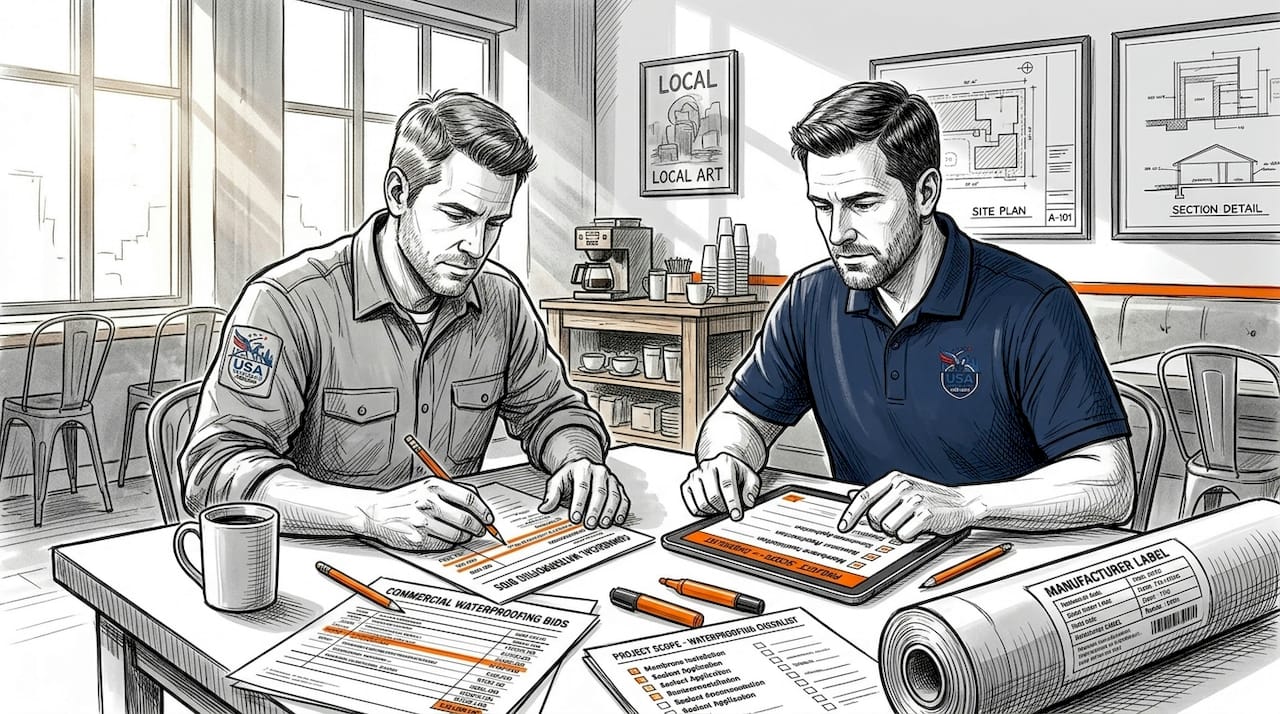
Start by insisting on itemized bids. Every line item from the expense breakdown listed earlier should appear separately. If a contractor provides a single lump-sum number, ask them to break it out. Contractors who refuse to itemize are usually hiding thin margins on materials or inflated labor rates.
Verify what is excluded. Ask each bidder specifically whether their price includes temporary waterproofing, equipment rental, permit fees, and structural repair allowances. Installation specifications such as membrane thickness, number of coating passes, and detailing at penetrations and drains should appear in writing. A bid that specifies two coats at 20 mils dry film thickness is a fundamentally different product than one that says "apply coating per manufacturer instructions."
- Require itemized line items with no lump-sum categories.
- Confirm inclusion or exclusion of temporary waterproofing and equipment costs.
- Compare installation specs, not just price per square foot.
- Request warranty terms in writing, including labor warranty coverage.
- Add a 10% to 15% contingency for structural repairs and site conditions.
- Consider life cycle cost: a $6/sq ft system lasting 25 years costs less over time than a $2/sq ft system replaced every 10 years.
Pro Tip: Ask each contractor how they handle unforeseen structural damage discovered during prep. Their answer tells you whether they have a clear change-order process or whether surprises will be handled informally and expensively.
You can also use resources like the USAConcreteJobs blog to research typical labor and material rates before you sit down with contractors. Knowing market rates going in gives you a much stronger position during bid review.
My take on what property managers consistently underestimate
I have reviewed hundreds of commercial waterproofing bids, and the pattern I see most often is property managers comparing prices without comparing scopes. They focus on the cost per square foot and miss the fact that one contractor is pricing two coats with full substrate repair and another is pricing a single coat over a surface that has not been properly cleaned.
The largest cost difference in commercial roof coatings is not the product. It is the quality of preparation and detailing. I have seen buildings where a cheaper bid saved $15,000 upfront and then required a full tear-off and replacement three years later at ten times the cost. The math on that decision is not complicated.
What I find equally underestimated is the value of specialist oversight on complex below-grade projects. Independent waterproofing specialists reduce risk and long-term costs by catching design errors before installation begins. That fee feels like an extra line item until you see what a failed below-grade system costs to remediate in an occupied commercial building.
My advice is to treat temporary waterproofing and structural repair allowances as non-negotiable inclusions in any bid you accept. Ask about project phasing and rain exposure before you sign. The contractors who answer those questions clearly and specifically are the ones worth hiring.
— Jack
Get connected with licensed waterproofing contractors
If you are ready to move from research to real bids, USAConcreteJobs connects you with licensed and insured contractors who specialize in commercial waterproofing and concrete work across Texas, Florida, California, Arizona, and Colorado.
The contractors in the USAConcreteJobs network provide itemized estimates, assist with permit applications, and bring the kind of site-specific experience that prevents the hidden cost surprises this article covers. Whether your project involves a flat commercial roof, a below-grade parking structure, or a large industrial facility, you can request a free estimate and get matched with a qualified contractor for your location. Visit USAConcreteJobs to get started, or explore state-specific options for commercial projects in Texas and Colorado.
FAQ
What are the main cost components in commercial waterproofing?
The primary components are surface preparation, waterproofing materials (coatings or membranes), drainage systems, labor, equipment rental, permits, and contractor overhead and profit. Comprehensive estimates list each as a separate line item.
How much does commercial waterproofing cost per square foot?
Costs range from $0.65 per square foot for acrylic coatings to $15.00 per square foot for TPO/PVC membrane systems. Full commercial roof system bids typically fall between $4.50 and $18.00 per square foot depending on system type and site conditions.
What hidden costs should I budget for?
The most commonly overlooked costs are temporary waterproofing ($2,000 to $10,000), structural repairs uncovered during prep work, hazardous material abatement ($3 to $8 per square foot for asbestos), and access logistics such as crane rental.
Why do two bids for the same building differ so much?
Bid differences usually reflect variations in prep scope, coating thickness, warranty coverage, and whether items like permits, equipment, and temporary waterproofing are included. Prep work and detailing drive cost more than the product itself, so a lower bid often means less preparation.
Should I hire a waterproofing specialist for design oversight?
For complex below-grade or large commercial projects, yes. An independent waterproofing designer typically costs between $8,000 and $20,000 but prevents design errors and installation disputes that cost significantly more to resolve after the fact.