
TL;DR:
- A concrete repair estimate specifies costs based on scope, materials, labor, and compliance, influencing repair success. Proper substrate testing and detailed line-item bids ensure accurate scope and prevent costly failure or change orders. When damage exceeds 40% or involves extensive corrosion, replacement often offers better long-term value than repair.
A concrete repair estimate is a formal cost assessment that defines the scope, materials, labor, and compliance requirements for restoring damaged concrete to structural or functional condition. Whether you own a home with a cracked driveway or manage a commercial property with deteriorating parking decks, getting an accurate estimate is the difference between a repair that holds and one that fails within two years. Costs vary widely: surface patching runs as low as $20 per square foot, while structural replacement can exceed $400 per square foot. Understanding what drives those numbers puts you in control of the bidding process before a contractor ever sets foot on your property.
What factors most influence your concrete repair cost estimate
The single biggest variable in any concrete repair cost estimate is the condition of the substrate beneath the visible damage. A crack on the surface may look minor, but if the rebar underneath is corroding or the concrete has delaminated, the repair scope expands significantly. Substrate testing including compressive strength, tensile pull-off, and delamination surveys defines where damage actually ends and where sound concrete begins. Without that data, contractors are guessing, and guesses lead to change orders.
Surface preparation is the second major driver. The International Concrete Repair Institute (ICRI) classifies surface profiles from CSP 1 through CSP 10, and labor costs range from $0.50 to $6 per square foot depending on which profile level the repair requires. A light acid etch sits at the low end; shot blasting or scarifying to CSP 7 sits at the high end. That spread alone can double your total labor bill on a mid-size project.
Material selection adds another layer of cost variation. Your main options are:
- Cementitious mortars: Lower material cost, widely available, best for non-structural patches and overlays
- Epoxy injection and epoxy mortars: Higher unit cost, superior bond strength, required for structural cracks and high-traffic surfaces
- Polymer-modified overlays: Mid-range cost, good for large surface areas with uniform shallow damage
- Corrosion inhibitors and compatible repair systems: Required when chloride corrosion is present to prevent the anodic ring effect from causing premature failure
Labor classification affects your bottom line in ways most homeowners never anticipate. On public or federally funded projects, the Davis-Bacon Act applies, and prevailing wage requirements raise labor costs by 20 to 40% compared to private-sector rates. Even on private projects, local union agreements in states like California and Illinois push labor rates well above national averages. Permitting and engineering inspections add fixed costs on top of that, particularly when repairs affect structural load paths.
Pro Tip: Ask every contractor to separate their bid into material, labor, surface prep, and compliance line items. A single lump-sum number tells you nothing about where costs are concentrated or where you can negotiate.
How repair urgency and scope change what you pay
Concrete repair cost assessment is not a single category. It covers a spectrum from cosmetic surface patching to full structural replacement, and the price gap between those endpoints is dramatic. Early detection of spalling keeps repair costs between $20 and $50 per square foot. Wait until the damage reaches the rebar, and you are looking at $50 to $150 per square foot for rebar treatment and partial depth repair. Let corrosion progress further and full replacement enters the picture at $150 to $400 or more per square foot.
The table below shows how repair type, urgency, and cost interact:
| Repair type | Typical cost range | When it applies |
|---|---|---|
| Surface patch | $20–$50 per sq ft | Early spalling, hairline cracks, no rebar exposure |
| Partial depth repair with rebar treatment | $50–$150 per sq ft | Exposed or corroded rebar, moderate delamination |
| Polymer overlay | $30–$80 per sq ft | Widespread shallow damage over large surface areas |
| Full slab replacement | $150–$400+ per sq ft | Structural failure, extensive corrosion, load-path compromise |
Structural repairs carry an additional cost layer that non-structural work does not. When a repair alters or restores a load-bearing element, a licensed professional engineer must review the scope, and most jurisdictions require permits and inspections before the work passes final approval. That engineering involvement adds fees ranging from a few hundred dollars on a simple residential repair to several thousand on a commercial deck or parking structure. Non-structural cosmetic repairs, by contrast, often require no permits at all in residential zones.
Pro Tip: If a contractor quotes you only for what is visible without recommending any substrate testing, treat that as a red flag. Repairs scoped without testing frequently fail within three to five years, costing you far more than the original repair.
Steps to get a concrete repair estimate from assessment to bid
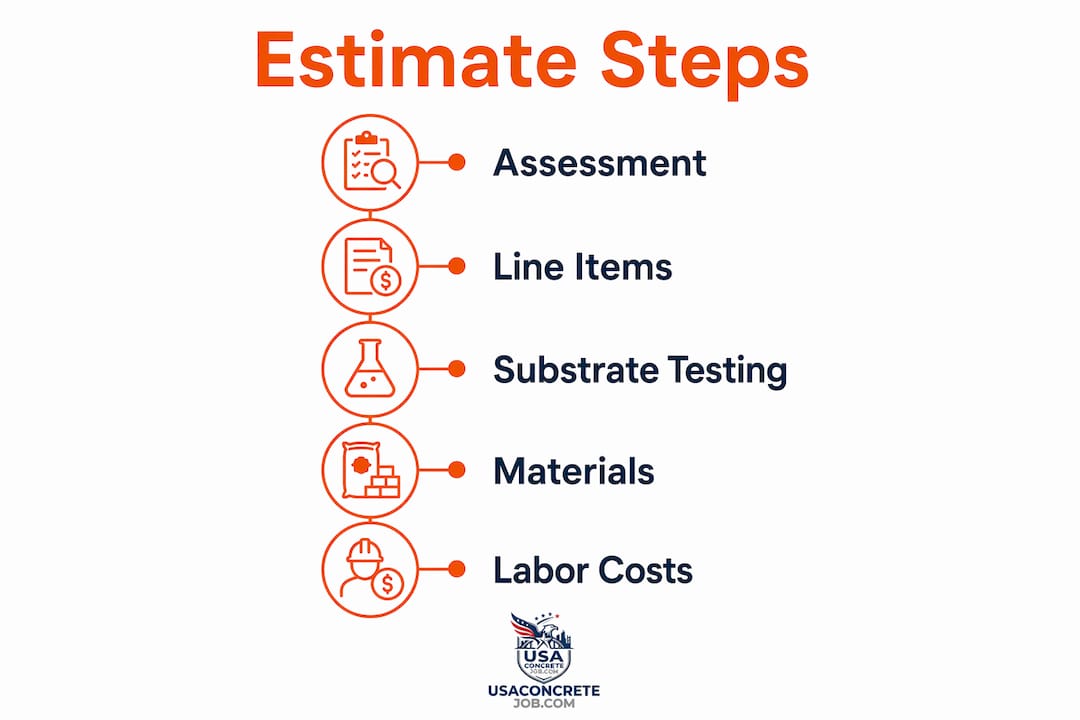
Getting a reliable estimate for concrete fixing follows a defined sequence. Skipping steps produces bids that are not comparable to each other and often miss the actual repair scope.
-
Conduct a condition assessment. Start with a visual survey, then move to non-destructive evaluation (NDE) methods such as sounding, ground-penetrating radar, or half-cell potential testing for rebar corrosion. Estimators treat visible damage as a symptom, using ASTM standards and ICRI surface profiles to define realistic repair boundaries. This step determines whether you need a patch or a full replacement.
-
Document the damage with measurements and photos. Contractors need square footage, crack lengths, depth of delamination, and photos of every affected area. The more precise your documentation, the faster and more accurate the bids you receive.
-
Request line-item bids from at least three contractors. A credible bid includes separate line items for surface preparation, materials by type and quantity, labor hours, equipment, permits, and engineering fees. Detailed estimates with quantity takeoffs and marked-up drawings are the standard for professional repair work. Bids that arrive as a single number are not comparable and not useful for budgeting.
-
Use digital estimating services when drawings are available. Services like ALM Estimating can produce verified estimates within 24 hours when you upload project drawings. The deliverables include Excel-formatted quantity sheets and marked-up drawings that you can hand directly to contractors for apples-to-apples comparison.
-
Request a second estimator review. On projects above $10,000, having a second estimator verify quantities and scope catches errors before they become expensive change orders. This step is standard practice on commercial projects and worth the cost on larger residential repairs.
When preparing your project information, include the following for faster and more accurate bids:
- Site address and access conditions (stairs, confined spaces, equipment restrictions)
- Existing drawings or as-built plans if available
- Any prior repair history and materials previously used
- Local permit requirements you have already confirmed
- Your preferred repair timeline and any scheduling constraints
You can also review resources on surface preparation methods to understand what contractors will need to do before any material goes down. That knowledge helps you evaluate whether a bid is realistic or underscoped.
Concrete repair vs replacement cost comparison: when does replacement win?
The concrete repair vs replacement cost comparison comes down to three factors: damage severity, underlying corrosion extent, and the expected service life of each option. Repair is almost always cheaper in the short term. Replacement delivers better long-term value when the substrate is compromised beyond what repair materials can reliably bond to.
Incomplete repairs on chloride-contaminated concrete are a specific failure mode worth understanding. Chloride corrosion requires comprehensive removal, steel cleaning, corrosion inhibitors, and compatible repair products to prevent the anodic ring effect. That effect causes corrosion to migrate to the edges of a repair patch, causing new spalling around the perimeter within a few years. A repair that does not address the root cause is not a repair. It is a temporary cosmetic fix that delays a larger expense.
Replacement becomes the better financial decision when:
- More than 40% of the slab area shows delamination or structural cracking
- Rebar corrosion is widespread and cannot be fully cleaned and treated within budget
- The existing concrete does not meet current load or code requirements
- Prior repairs have already failed in the same location
For a standard residential driveway in Texas or Florida, full replacement typically runs $6 to $12 per square foot for a new 4-inch slab. A targeted partial-depth repair on the same driveway might cost $35 to $60 per square foot for the damaged sections only. If less than 20% of the surface is damaged, repair wins on cost. If damage is widespread, the math often favors replacement. A detailed estimate that breaks out quantities by repair type makes this comparison concrete rather than speculative.
Key takeaways
Accurate concrete repair estimates require condition assessment, line-item bids, and a clear understanding of whether repair or replacement delivers better long-term value for your specific damage scenario.
| Point | Details |
|---|---|
| Substrate testing drives scope | Compressive strength and delamination testing define true repair boundaries and prevent under-scoping. |
| Repair urgency controls cost | Early spalling repairs cost $20 to $50 per sq ft; delayed structural repairs reach $400 per sq ft. |
| Line-item bids are non-negotiable | Bids must separate materials, labor, surface prep, and compliance fees to be comparable. |
| Structural repairs need engineer review | Load-path repairs require a licensed PE, permits, and inspections under most building codes. |
| Repair vs replacement depends on damage extent | When delamination covers more than 40% of a slab, full replacement often costs less over time. |
Why I tell every property owner to demand the assessment first
I have reviewed hundreds of concrete repair bids over the years, and the pattern that costs property owners the most money is consistent: they accept the lowest bid without verifying that the contractor assessed the substrate. A contractor who quotes based on visual inspection alone is pricing what they can see, not what they will find. That gap shows up as a change order two weeks into the job, after the surface prep reveals corroded rebar or a delaminated base layer that was never included in the original scope.
The fix is straightforward. Before you accept any bid, ask the contractor to show you their condition assessment report. If they do not have one, ask them to produce one before finalizing the quote. On projects above $5,000, the cost of a proper assessment is a fraction of what a missed scope item will cost you. I have seen a $3,000 assessment prevent a $25,000 change order on a commercial parking deck in Arizona.
The other mistake I see regularly is treating all bids as equivalent when they are not scoped the same way. One contractor prices a surface overlay. Another prices partial-depth repair with rebar treatment. A third prices full replacement. All three are responding to the same visible damage, but they are not bidding the same job. You cannot compare those numbers without a shared condition assessment and a defined repair scope. Demand that both exist before you collect a single bid. The contractors who push back on that request are telling you something important about how they operate.
— Jack
Get licensed concrete repair contractors and free estimates fast

USAConcreteJobs connects homeowners and property managers with licensed, insured concrete repair contractors across Texas, Florida, California, Arizona, and Colorado. Every contractor in the network carries proper licensing and insurance, and the platform supports permit assistance to keep your project compliant with local codes. You can request a free estimate by submitting your project details and any available drawings, and contractors respond with line-item bids that cover materials, labor, surface prep, and compliance costs. For faster service, call (833) 722-3359 to speak directly with a contractor coordinator who can match you with the right specialist for your repair type and location. Do not let unscoped bids or delayed repairs drive your costs higher than they need to be.
FAQ
What is included in a concrete repair estimate?
A complete concrete repair estimate includes separate line items for surface preparation, materials by type and quantity, labor, equipment, permits, and engineering fees. Estimates accompanied by quantity takeoffs and marked-up drawings are the professional standard and allow accurate comparison between contractors.
How much does a concrete repair cost on average?
Average concrete repair prices range from $20 to $50 per square foot for surface patching and up to $400 per square foot for structural replacement. The final cost depends on damage depth, substrate condition, repair method, and local labor rates.
When should I repair concrete instead of replacing it?
Repair is the better choice when damage covers less than 20 to 40% of the surface and the substrate is structurally sound. Full replacement becomes more cost-effective when delamination is widespread, rebar corrosion is extensive, or prior repairs have already failed.
How do prevailing wage laws affect my concrete repair bid?
On public or federally funded projects, the Davis-Bacon Act requires contractors to pay prevailing wages, which raises labor costs by 20 to 40% compared to private-sector rates. Always confirm whether your project falls under prevailing wage requirements before comparing bids.
Can I get free concrete repair quotes online?
Yes. Platforms like USAConcreteJobs provide free concrete repair quotes by connecting you with licensed contractors who review your project details and submitted drawings. Digital estimating services can also deliver verified quantity takeoffs within 24 hours when drawings are available.